About
I am a Principal Applied Scientist at Amazon, where I work on large-scale reinforcement learning for supply-chain decision making. My research focuses on learning systems that coordinate large populations of agents, operate under shared constraints, and make good decisions in complex real-world environments.
I also work on language models and autonomous agents, particularly reasoning and self-improvement, with current projects in post-training for code synthesis, test-time compute, and verifiable agent systems.
I received my PhD from Princeton University in 2019, advised by Han Liu.
Language models, reasoning, and agents
- Reasoning and self-improvement. When can LLMs improve themselves? A formalization through the generation-verification gap, and how it scales with pretraining compute. Separately, structured intermediate representations, from functional programs to formal specifications, that make models markedly better at generating verified code and proofs, both at inference time and as post-training targets. [68]
- Agents. L3M, a multi-agent runtime and coding-agent harness written in Lean 4 whose guarantees about authority, delegation, and effects are machine-checked theorems. I also work on measuring and improving agentic systems end to end. [24]
- Post-training and test-time compute. Post-training, including RL with verifiable rewards for code synthesis, and test-time strategies for improving decoding: learned decoding policies that allocate compute over a model's token tree, trained with behavior cloning and RL, and curriculum design for RL fine-tuning (in progress). [16]
Reinforcement learning and large-scale decision systems
- Equilibria and coordination in multi-agent systems. What are the right signals to pass between hundreds of thousands of agents sharing constrained resources, and how do we learn them? [57911]
- World models, policy evaluation, and sim-to-real. When can we know, before deployment, that a learned policy will actually work? I study settings where policies can be evaluated exactly from historical data, and settings where learned simulators let us make transfer empirically testable. [510111214]
- Structured policies and their gradients. Variance-reduced policy gradients for bounded and structured action spaces, and policies that act through differentiable convex optimization layers with learned value functions. [31617]
News
- Oct 2026Diffusion Models for Code Verification accepted to the NeurIPS 2026 Workshop on AI for Verifiable Coding.
- Oct 2026I gave a short talk and demo of L3M at the COLM 2026 expo (slides).
- Sep 2026New preprint: Proximal Residual Value Functions for consistent planning and real-time execution.
- Aug 2026Beyond the Harness accepted to the COLM 2026 Workshop on Context Beyond the Window.
- May 2026New preprint: Ready from Day 1, on sim-to-real transfer of coordination policies for large populations of agents.
- 2026BRIDGE accepted to the ICML 2026 AI4Math Workshop.
Publications and preprints
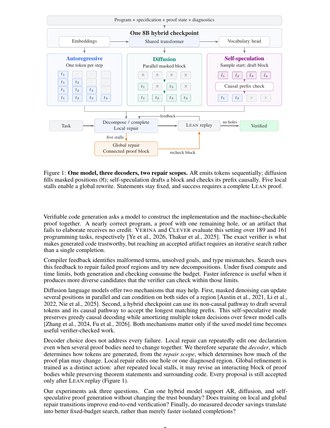
Abstract
Large language models have made candidate programs cheap to produce, but not cheap to trust. A plausible completion may compile, pass a finite test suite, and still violate its intended behavior. Program verification closes this gap by pairing an implementation with a formal specification and a machine-checked proof that the implementation satisfies it. The proof kernel provides the trust boundary, but finding a proof remains an expensive search over decompositions, completions, and repairs. Decoder speed therefore matters: within the same wall-clock budget, faster generation permits more candidates to reach the exact verifier. We study whether diffusion language models can turn parallel token generation and bidirectional repair into useful verified search. We train one 8B hybrid model on 600,000 verifier-filtered construction, local-repair, and global-repair transitions. The same weights run autoregressively, as native masked diffusion, or with self-speculative decoding. To our knowledge, this is the first diffusion language model trained for end-to-end program verification in Lean, where success requires a kernel-checked program, specification, and proof. We further introduce global refinement, a verifier-gated action that revises an interacting proof region after repeated local failure. Our autoregressive global system verifies 56% of VERINA tasks and 66/161 (41.0%) CLEVER tasks; the Goedel-Code-Prover baseline reaches 52.4% and 34.8%, respectively. Self-speculation with global refinement reaches 59.3% and 49.1%. In a controlled 8B audit, self-speculation preserves verified accuracy while reducing mean generation latency by 4.8× and neural evaluations by 5.09×. Native diffusion exposes a stronger speed–accuracy trade-off. These results show that diffusion is most useful for verification when its saved model calls are coupled to verifier-checked search rather than treated as raw decoding throughput.
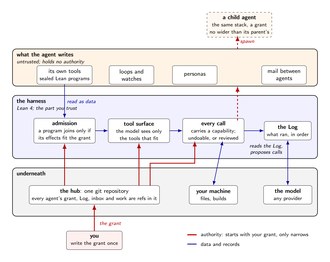
Abstract
Agents now do real work: they edit code, run experiments, author documents, and spawn other agents to do the same. The harness that turns a model's text into those effects holds all of the authority the model appears to exercise, and in most systems it is an afterthought. L3M is a verifiable harness and runtime for self-extending and self-improving agents, written in Lean 4, in which the properties that make it safe are theorems about the code that runs, checked on every build. Lean plays three roles at once: it is the language L3M is written in, the language its guarantees are proved in, and the language its agents extend it in. That third role makes L3M a new programming model in which each party does what it is best at: the model decides what to do and composes the pieces, code loops, computes, and enforces, and the human judges what matters and decides whom to trust. An agent turns its plan into a sealed program whose type is its permission request, so the loop runs as code with guarantees and the model reasons once over the result: what the agent can do grows, but what it is allowed to do does not. Every authority an agent holds traces back to a human's grant as an unforgeable token, and grants can only narrow as agents spawn children. Reversibility, derived from each tool's footprint, decides which actions need review, and review itself is a deliberation between agents, with the human consulted on effects rather than shell strings. A Git-backed distributed runtime makes the permission, ref, and directory trees one tree, so guarantees proved for an agent hold for its whole subtree, and because an agent's behaviour is a fold over what Git stores, the loops that measure and improve agents run inside L3M as ordinary bounded agents.
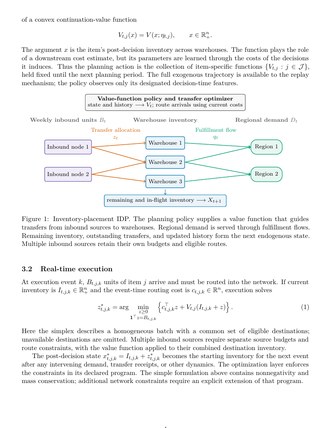
Abstract
We study two-timescale decision systems in which a planning layer periodically supplies a continuation-value function to a real-time optimizer that allocates arriving resources, with inventory placement as our motivating application. We propose an end-to-end reinforcement learning (RL) method for learning this function using proximal residual value functions, which combine a strictly convex potential of post-decision inventory with a learned convex residual. This general form yields a well-posed optimization layer that supports end-to-end differentiation while preserving an explicit convex objective for real-time execution. We characterize the necessary and sufficient conditions under which a smooth value function yields decisions that are consistent across the planning and execution timescales. In an offline simulation using historical inventory arrival and demand patterns from a large e-commerce retailer, learned proximal residual value functions reduce total routing and transfer cost relative to a historical-production-system proxy by 5.0%.
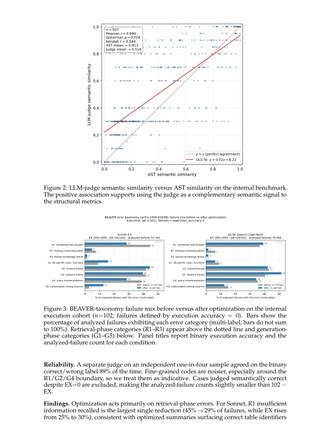
Abstract
Deploying LLMs for enterprise Text-to-SQL is bottlenecked less by the model than by what context reaches it: business logic spans thousands of tables, and no model can ingest a full catalog at once. We argue that the most effective place to intervene is therefore the knowledge-base context the model consumes, and that this context should be constructed from historical usage rather than tuned for as a fixed input. Using a query-DAG decomposition recovered from production SQL, we compare the value of oracle query graphs versus retrieved knowledge-base context, and optimize a distillation procedure that turns historical query profiles into reusable SQL reference cards. On a benchmark of 5176 production queries from a major online retailer, optimizing these context artifacts yields larger gains (~12-25% AST similarity) than optimizing the retrieval harness (~3-12%).
Abstract
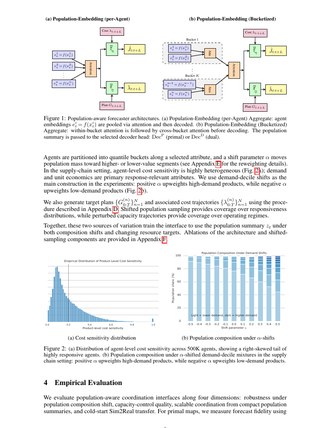
In large-scale multi-agent systems with shared resource constraints, an upstream planner must iteratively evaluate candidate resource plans before committing to one. Lagrangian relaxation separates local decisions through a broadcast cost signal, but the planner still needs the cost-to-utilization response map, which depends on population composition that changes across planning cycles. We propose population-aware coordination interfaces: learned primal and dual maps, conditioned on compact population summaries, that the planner queries inside its iterative loop. These maps remain reliable across evolving populations without per-cycle retraining, and support coordination of large populations from compact subsamples. In a supply-chain capacity-control case study, population-aware interfaces reduce forecast error by 16-19% and capacity violations by 20-51% relative to population-unaware baselines under composition shift; 20K-agent cohorts support accurate coordination of 500K-agent populations.
Abstract
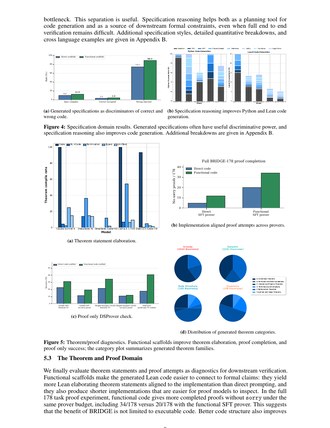
BRIDGE is a framework for improving verified program synthesis with large language models. The approach decomposes verification into three interconnected domains: Code (implementations), Specifications (formal intent), and Theorem Statements. BRIDGE uses a code-first workflow, using the generated implementation as a semantic anchor for downstream specification and theorem statement generation. Evaluated across five LLMs on 178 algorithmic problems, the method achieves nearly 1.5x better Lean executable correctness compared to baselines and demonstrates 2x more sample-efficient inference. The framework also improves Python pass rates by up to 17.5% through specification-driven prompting. Supervised fine-tuning with BRIDGE-style reasoning yields nearly 1.5x higher Lean pass success than code-only SFT.
Abstract
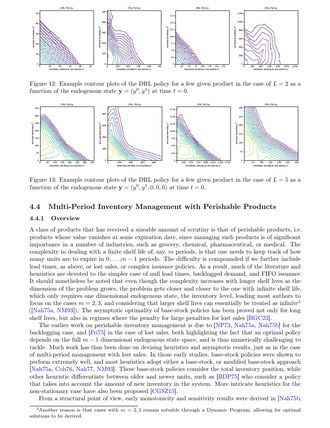
This paper investigates the application of Deep Reinforcement Learning (DRL) to classical inventory management problems, with a focus on practical implementation considerations. We apply a DRL algorithm based on DirectBackprop to several fundamental inventory management scenarios including multi-period systems with lost sales (with and without lead times), perishable inventory management, dual sourcing, and joint inventory procurement and removal. The DRL approach learns policies across products using only historical information that would be available in practice, avoiding unrealistic assumptions about demand distributions or access to distribution parameters. We demonstrate that our generic DRL implementation performs competitively against or outperforms established benchmarks and heuristics across these diverse settings, while requiring minimal parameter tuning. Through examination of the learned policies, we show that the DRL approach naturally captures many known structural properties of optimal policies derived from traditional operations research methods. To further improve policy performance and interpretability, we propose a Structure-Informed Policy Network technique that explicitly incorporates analytically-derived characteristics of optimal policies into the learning process. This approach can help interpretability and add robustness to the policy in out-of-sample performance, as we demonstrate in an example with realistic demand data. Finally, we provide an illustrative application of DRL in a non-stationary setting. Our work bridges the gap between data-driven learning and analytical insights in inventory management while maintaining practical applicability.
Abstract
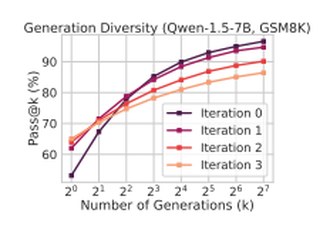
Self-improvement is a mechanism in Large Language Model (LLM) pre-training, post-training and test-time inference. We explore a framework where the model verifies its own outputs, filters or reweights data based on this verification, and distills the filtered data. Despite several empirical successes, a fundamental understanding is still lacking. In this work, we initiate a comprehensive, modular and controlled study on LLM self-improvement. We provide a mathematical formulation for self-improvement, which is largely governed by a quantity which we formalize as the generation-verification gap. Through experiments with various model families and tasks, we discover a scaling phenomenon of self-improvement -- a variant of the generation-verification gap scales monotonically with the model pre-training flops. We also examine when self-improvement is possible, an iterative self-improvement procedure, and ways to improve its performance. Our findings not only advance understanding of LLM self-improvement with practical implications, but also open numerous avenues for future research into its capabilities and boundaries.
Abstract
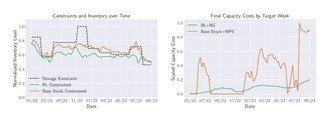
This paper addresses the capacitated periodic review inventory control problem, focusing on a retailer managing multiple products with limited shared resources, such as storage or inbound labor at a facility. Specifically, this paper is motivated by the questions of (1) what does it mean to backtest a capacity control mechanism, (2) can we devise and backtest a capacity control mechanism that is compatible with recent advances in deep reinforcement learning for inventory management? First, because we only have a single historic sample path of Amazon's capacity limits, we propose a method that samples from a distribution of possible constraint paths covering a space of real-world scenarios. This novel approach allows for more robust and realistic testing of inventory management strategies. Second, we extend the exo-IDP (Exogenous Decision Process) formulation of Madeka et al. 2022 to capacitated periodic review inventory control problems and show that certain capacitated control problems are no harder than supervised learning. Third, we introduce a `neural coordinator', designed to produce forecasts of capacity prices, guiding the system to adhere to target constraints in place of a traditional model predictive controller. Finally, we apply a modified DirectBackprop algorithm for learning a deep RL buying policy and a training the neural coordinator. Our methodology is evaluated through large-scale backtests, demonstrating RL buying policies with a neural coordinator outperforms classic baselines both in terms of cumulative discounted reward and capacity adherence (we see improvements of up to 50% in some cases).
Abstract
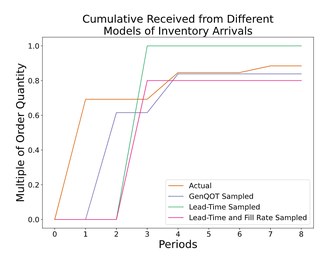
In this paper we address the problem of learning and backtesting inventory control policies in the presence of general arrival dynamics -- which we term as a quantity-over-time arrivals model (QOT). We also allow for order quantities to be modified as a post-processing step to meet vendor constraints such as order minimum and batch size constraints -- a common practice in real supply chains. To the best of our knowledge this is the first work to handle either arbitrary arrival dynamics or an arbitrary downstream post-processing of order quantities. Building upon recent work (Madeka et al., 2022) we similarly formulate the periodic review inventory control problem as an exogenous decision process, where most of the state is outside the control of the agent. Madeka et al. (2022) show how to construct a simulator that replays historic data to solve this class of problem. In our case, we incorporate a deep generative model for the arrivals process as part of the history replay. By formulating the problem as an exogenous decision process, we can apply results from Madeka et al. (2022) to obtain a reduction to supervised learning. Finally, we show via simulation studies that this approach yields statistically significant improvements in profitability over production baselines. Using data from an ongoing real-world A/B test, we show that Gen-QOT generalizes well to off-policy data.
Abstract
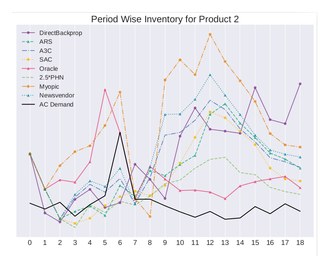
This work provides a Deep Reinforcement Learning approach to solving a periodic review inventory control system with stochastic vendor lead times, lost sales, correlated demand, and price matching. While this dynamic program has historically been considered intractable, our results show that several policy learning approaches are competitive with or outperform classical methods. In order to train these algorithms, we develop novel techniques to convert historical data into a simulator. On the theoretical side, we present learnability results on a subclass of inventory control problems, where we provide a provable reduction of the reinforcement learning problem to that of supervised learning. On the algorithmic side, we present a model-based reinforcement learning procedure (Direct Backprop) to solve the periodic review inventory control problem by constructing a differentiable simulator. Under a variety of metrics Direct Backprop outperforms model-free RL and newsvendor baselines, in both simulations and real-world deployments.
Abstract
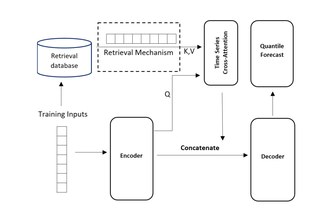
Multi-horizon probabilistic time series forecasting has wide applicability to real-world tasks such as demand forecasting. Recent work in neural time-series forecasting mainly focus on the use of Seq2Seq architectures. For example, MQTransformer - an improvement of MQCNN - has shown the state-of-the-art performance in probabilistic demand forecasting. In this paper, we consider incorporating cross-entity information to enhance model performance by adding a cross-entity attention mechanism along with a retrieval mechanism to select which entities to attend over. We demonstrate how our new neural architecture, MQRetNN, leverages the encoded contexts from a pretrained baseline model on the entire population to improve forecasting accuracy. Using MQCNN as the baseline model (due to computational constraints, we do not use MQTransformer), we first show on a small demand forecasting dataset that it is possible to achieve ~3% improvement in test loss by adding a cross-entity attention mechanism where each entity attends to all others in the population. We then evaluate the model with our proposed retrieval methods - as a means of approximating an attention over a large population - on a large-scale demand forecasting application with over 2 million products and observe ~1% performance gain over the MQCNN baseline.
Abstract
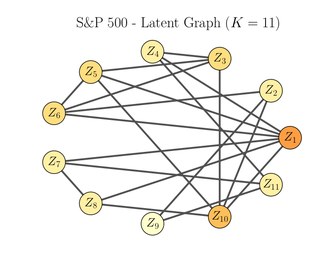
Motivated by modern applications in which one constructs graphical models based on a very large number of features, this paper introduces a new class of cluster-based graphical models. Unlike standard graphical models, variable clustering is applied as an initial step for reducing the dimension of the feature space. We employ model assisted clustering, in which the clusters contain features that are similar to the same unobserved latent variable. Two different cluster-based Gaussian graphical models are considered: the latent variable graph, corresponding to the graphical model associated with the unobserved latent variables, and the cluster-average graph, corresponding to the vector of features averaged over clusters. We derive estimates tailored to these graphs, with the goal of pattern recovery under false discovery rate (FDR) control. Our study reveals that likelihood based inference for the latent graph is analytically intractable, and we develop alternative estimation and inference strategies. We replace the likelihood of the data by appropriate empirical risk functions that allow for valid inference in both graphical models under study. Our main results are Berry-Esseen central limit theorems for the proposed estimators, which are proved under weaker assumptions than those employed in the existing literature on Gaussian graphical model inference. We make explicit the implications of the asymptotic approximations on graph recovery under FDR control, and show when it can be controlled asymptotically. Our analysis takes into account the uncertainty induced by the initial clustering step. We find that the errors induced by clustering are asymptotically ignorable in the follow-up analysis, under no further restrictions on the parameter space for which inference is valid. The theoretical properties of the proposed procedures are verified on simulated data and an fMRI data analysis.
Abstract
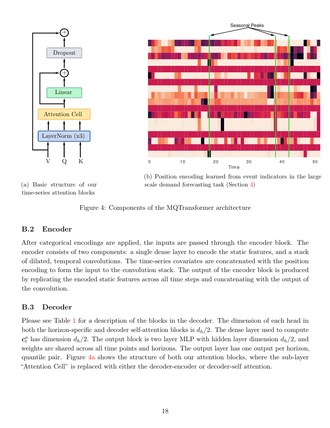
Recent advances in neural forecasting have produced major improvements in accuracy for probabilistic demand prediction. In this work, we propose novel improvements to the current state of the art by incorporating changes inspired by recent advances in Transformer architectures for Natural Language Processing. We develop a novel decoder-encoder attention for context-alignment, improving forecasting accuracy by allowing the network to study its own history based on the context for which it is producing a forecast. We also present a novel positional encoding that allows the neural network to learn context-dependent seasonality functions as well as arbitrary holiday distances. Finally we show that the current state of the art MQ-Forecaster (Wen et al., 2017) models display excess variability by failing to leverage previous errors in the forecast to improve accuracy. We propose a novel decoder-self attention scheme for forecasting that produces significant improvements in the excess variation of the forecast.
 [15] Efficient, Certifiably Optimal Clustering with Applications to Latent Variable Graphical Models
Abstract
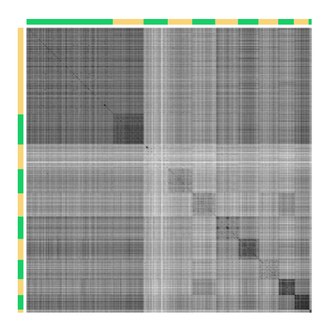
We consider SDP relaxation methods for data and variable clustering problems, which have been shown in the literature to have good statistical properties in a variety of settings, but remain intractable to solve in practice. In particular, we propose FORCE, a new algorithm to solve the Peng-Wei $K$-means SDP. Compared to the naive interior point method, our method reduces the computational complexity of solving the SDP from $\\tilde{O}(d^7 \\log \\epsilon^{-1})$ to $\\tilde{O}(d^{6}K^{-2}\\epsilon^{-1})$. Our method combines a primal first-order method with a dual optimality certificate search, which when successful, allows for early termination of the primal method. We show under certain data generating distributions that, with high probability, FORCE is guaranteed to find the optimal solution to the SDP relaxation and provide a certificate of exact optimality. As verified by our numerical experiments, this allows FORCE to solve the Peng-Wei SDP with dimensions in the hundreds in only tens of seconds. We also consider a variation of the Peng-Wei SDP for the case when $K$ is not known a priori and show that a slight modification of FORCE reduces the computational complexity of solving this problem as well: from $\\tilde{O}(d^7 \\log \\epsilon^{-1})$ using a standard SDP solver to $\\tilde{O}(d^{4}\\epsilon^{-1})$.

Abstract
Many complex domains, such as robotics control and real-time strategy (RTS) games, require an agent to learn a continuous control. In the former, an agent learns a policy over $\mathbb{R}^d$ and in the latter, over a discrete set of actions each of which is parametrized by a continuous parameter. Such problems are naturally solved using policy based reinforcement learning (RL) methods, but unfortunately these often suffer from high variance leading to instability and slow convergence. We show that in many cases a substantial portion of the variance in policy gradient estimators is completely unnecessary and can be eliminated without introducing bias. Unnecessary variance is introduced whenever policies over bounded action spaces are modeled using distributions with unbounded support, by applying a transformation T to the sampled action before execution in the environment. Recent works have studied variance reduced policy gradients for actions in bounded intervals, but to date no variance reduced methods exist when the action is a direction -- constrained to the unit sphere -- something often seen in RTS games. To address these challenges we: (1) introduce a stochastic policy gradient method for directional control; (2) introduce the marginal policy gradient framework, a powerful technique to obtain variance reduced policy gradients for arbitrary $T$; (3) show that marginal policy gradients are guaranteed to reduce variance, quantifying that reduction exactly; (4) validate our framework by applying the methods to a popular RTS game and a navigation task, demonstrating improvement over a policy gradient baseline.
Abstract
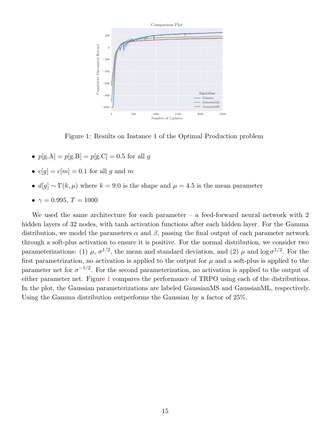
Recent work has highlighted how a misalignment between the support of the policy and the action space of the reinforcement learning problem can introduce bias and unnecessary variance into policy gradient estimates. To better align the support of the policy and the action space, we can consider using arbitrary exponential families to model the policy distribution. Exponential families are a natural choice because the class of exponential families is very rich and can model the support of most action spaces of practical interest. While the multivariate Gaussian is the most commonly used distribution today, in general it is possible to efficiently implement both natural policy gradient and TRPO for any exponential family. In this technical report we derive efficient natural policy gradient update rules for several exponential familes. We also consider an application of the Gamma distribution to an optimal production problem and show that it substantially outperforms the Gaussian.
Abstract
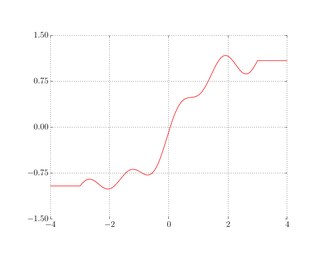
We provide a principled framework for non-parametrically learning activation functions in deep neural networks. Currently, state-of-the-art deep networks treat choice of activation function as a hyper-parameter before training. By allowing activation functions to be estimated as part of the training procedure, we expand the class of functions that each node in the network can learn. Building on recent advances in stability bounds for stochastic gradient methods, we provide a theoretical justification for our choice of nonparametric activation functions and demonstrate that networks with our nonparametric activation functions generalize well. To demonstrate the power of our novel techniques, we test them on image recognition datasets and achieve up to a 15% relative increase in test performance compared to the baseline.
Education
- PhD, Operations Research and Financial Engineering Princeton University, 2019
- M.A., Operations Research and Financial Engineering Princeton University, 2016
- B.A., Mathematics and Computer Science Williams College, 2014